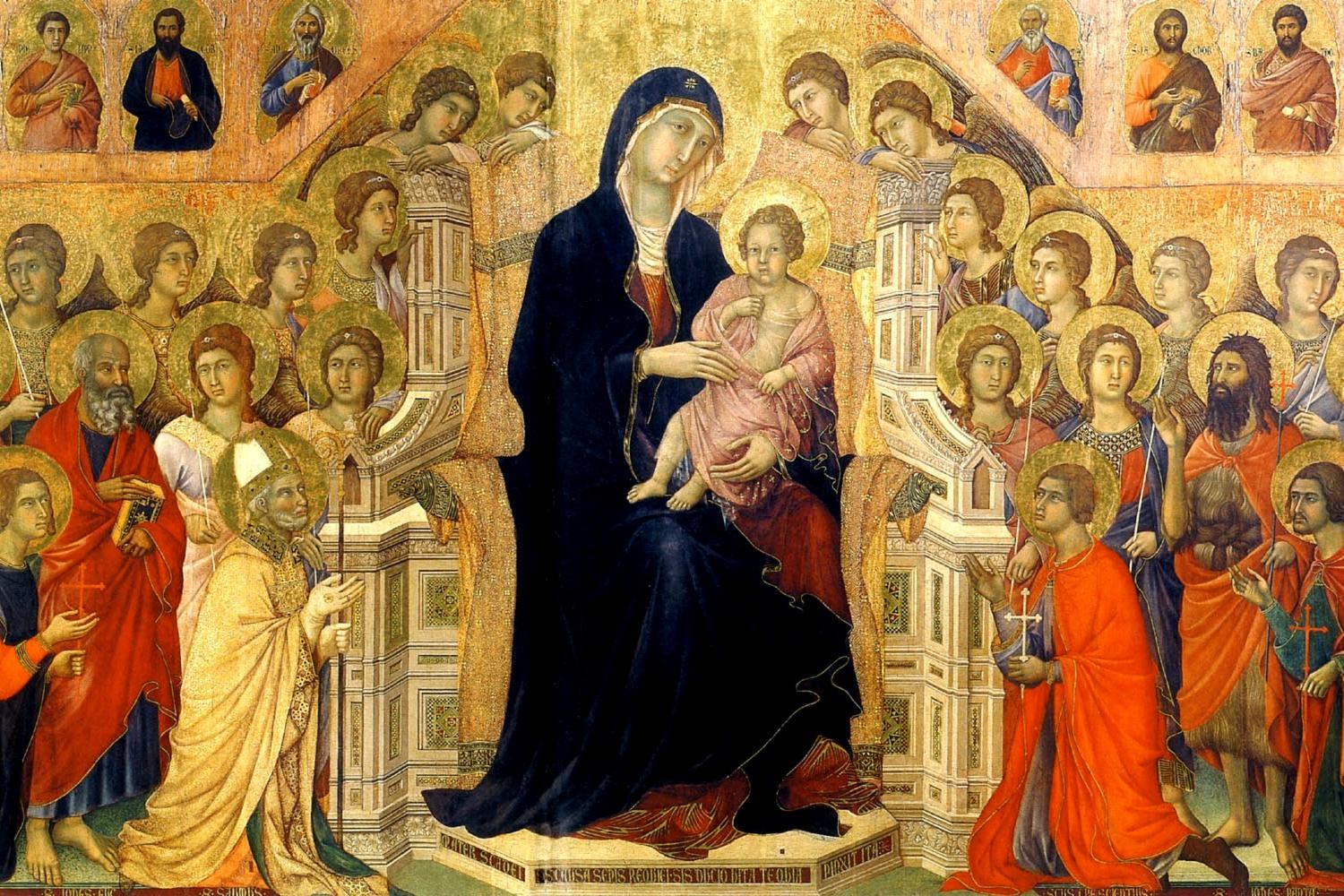
Historically speaking, we can only see from some early church fathers are their quotations on what they believed concerning Mary being the God-bearer (theotokos) but never ascribing to the kind of ascription made by the Roman Catholic institution in the west. In fact, the idea that Mary continued to be a virgin became a common belief in the church had its beginning only in the second century and continuing down to the Middle Ages. It is also unfortunate that as the eastern and western churches debated on the role of Mary as theotokos, the Latin fathers in the west started to label Mary as sinless. The term theotokos was first used by Alexander, bishop of Alexandria in 319 AD, but made popular by Athanasius (295-373 AD) in his debate against the Arians who questioned the deity of Jesus Christ in which he states,
“Now the scope and character of Holy Scripture, as we have often said, is this—it contains a double account of the Saviour; that He was ever God, and is the Son, being the Father’s Word and Radiance and Wisdom; and that afterwards for us He took flesh of a Virgin, Mary Bearer of God [theotokou], and was made man.”1
Actually, his used of theotokos was not for the purposed of Mariology but Christology. Even John Chrysostom (334-407 AD) comments on Mary’s standing when he expounded on Matthew 12:46-50,
“And with what purpose He reproved; that it was not with intent to drive them to perplexity, but to deliver them from the most tyrannical passion and to lead them on by little and little to the right idea concerning Himself, and to convince her [Mary] that He was not her Son only, but also her Lord: so wilt thou perceive that the reproof is in the highest degree both becoming Him and profitable to her, and withal having in it much gentleness.”2
One of the church fathers named Ambrose of Milan (337-397), in his desire to explain the incarnation of Jesus Christ was not careful enough in his wordings paving the way to a high Mariology though cautioning the practice of Mariolatry. Sadly, his writings pave the way to an extended veneration towards Mary.
As you can see, a good number of the early church fathers started to veer away from the Scriptures by slowly introducing Mary’s unusual role in Christianity. Jerome (331-419) contributed towards Mary’s role being a Co-Redemptrix because of his latin Vulgate’s translation of Genesis 3:15. Augustine of Hippo (354-443) upgraded Mary’s role as being free from original sin in his desire to combat Pelagius.
The Second Council of Nicaea (A.D. 787) introduced three levels of worship: dulia, hyperdulia, and latria. The term dulia means veneration applied to the saints and icons. While latria is a term used for worshipping God alone, and lastly hyperdulia (that is, hyperveneration) applies to Mary.
These are not the teachings of the early apostles but was slowly introduced by some church fathers via Tradition. It is no wonder that the Roman Catholic teachers started to place Tradition at par with the Scripture because without which they have no basis for venerating Mary and the saints. As a reminder, the early church fathers writings are not to be considered infallible and authoritative. Their writings are still to be under the authority of the inspired Word of God written by the prophets and the apostles.
It is truly unfortunate to know that some so-called “pastors” and “believers” in our modern-day are now embracing the teachings of the Roman Catholic institution instead of being contended with the inspired Word of God. I believed these few prominent former “evangelicals” who have crossed the Tiber need to be clear of their stand on Mariology. Do they now talk to Mary? Do they believed Mary is the Queen of Heaven? Do they already believed Mary is the Mediatrix of all Grace? Do they already embraced Mary as the Queen of the Apostles? Are they willing to confess that Mary is a Co-Redemptrix with Christ? They need to give a clear stand to these things in order for us to know if they truly agree with the Roman Catholic institution’s teachings. How about you? Are you willing to confessed Mary as Our Lady of Refuge of Sinners, Gate of Heaven, Mother of Mercies, Immaculate Virgin,. Spouse of the Holy Ghost, Mother of Perpetual Help, Queen of Angels, Queen of All Saints, Queen of Martyrs, Holy Virgin of virgins, Mirror of Justice, Seat of Wisdom, Morning Star, Comforter of the Afflicted, and Christ’s Associate? These are not teachings from the Scriptures but exaltation of Mary that were intensified over the years. As for me, I will still echo what Martin Luther has boldly stated in front of the Roman Catholic popes when he said,
“Unless I am convinced by Scripture and plain reason – I do not accept the authority of the popes and councils, for they have contradicted each other – my conscience is captive to the Word of God. I cannot and I will not recant anything for to go against conscience is neither right nor safe. God help me. Amen.”
It is my hope and prayer that believers will continue to confess Jesus to be the Lord and Savior just like what the biblical Mary said,
And Mary said, “My soul magnifies the Lord, and my spirit rejoices in God my Savior, – Luke 1:46-47
Footnotes:
1 Athanasius, “Four Discourses Against the Arians 3.29,” in Nicene and Post- Nicene Fathers: Second Series, ed. Philip Schaff and Henry Wace, Reprint ed., vol. 4 (Peabody, MA: Hendrickson Publishers, 1994), 409.
2 Chrysostom, “Homilies on Matthew 44.1,” in Nicene and Post-Nicene Fathers: First Series, ed. Philip Schaff, Reprint ed., vol. 10 (Peabody, MA: Hendrickson Publishers, 1994), 279.

0 Comments