For to us a child is born, to us a son is given; and the government shall be upon his shoulder, and his name shall be called Wonderful Counselor, Mighty God, Everlasting Father, Prince of Peace. – Isaiah 9:6
Whenever Christmas approaches, we can hear many pastors and church leaders quote from Isaiah 9:6 using it as a jumping board to explain God’s fatherhood relationship with HIs people. It is surprising that many believers would use the “name” of Jesus Christ, that is, “Everlasting Father” in Isaiah 9:6 to explain the role of a father on a Father’s Day or explaining the relationship of children with their fathers. Why misinterpret this passage when there are a number of verses in the Bible that explains in context of what relationship with a father is all about? I even heard one worship leader saying, “Thank you Father for dying on the cross for my sins.” In theology, we call this as the heresy of Patripassianism wherein the Father suffered on the cross. Many Christians seem to be uneducated in terms of explaining and understanding many challenging passage like this a reason why cults continue to abound. Many Christians may be uneducated in explaining passages like this but many of them are teachable. However, it is different with the Oneness people because many of them are arrogant to received theological correction and even adamant.
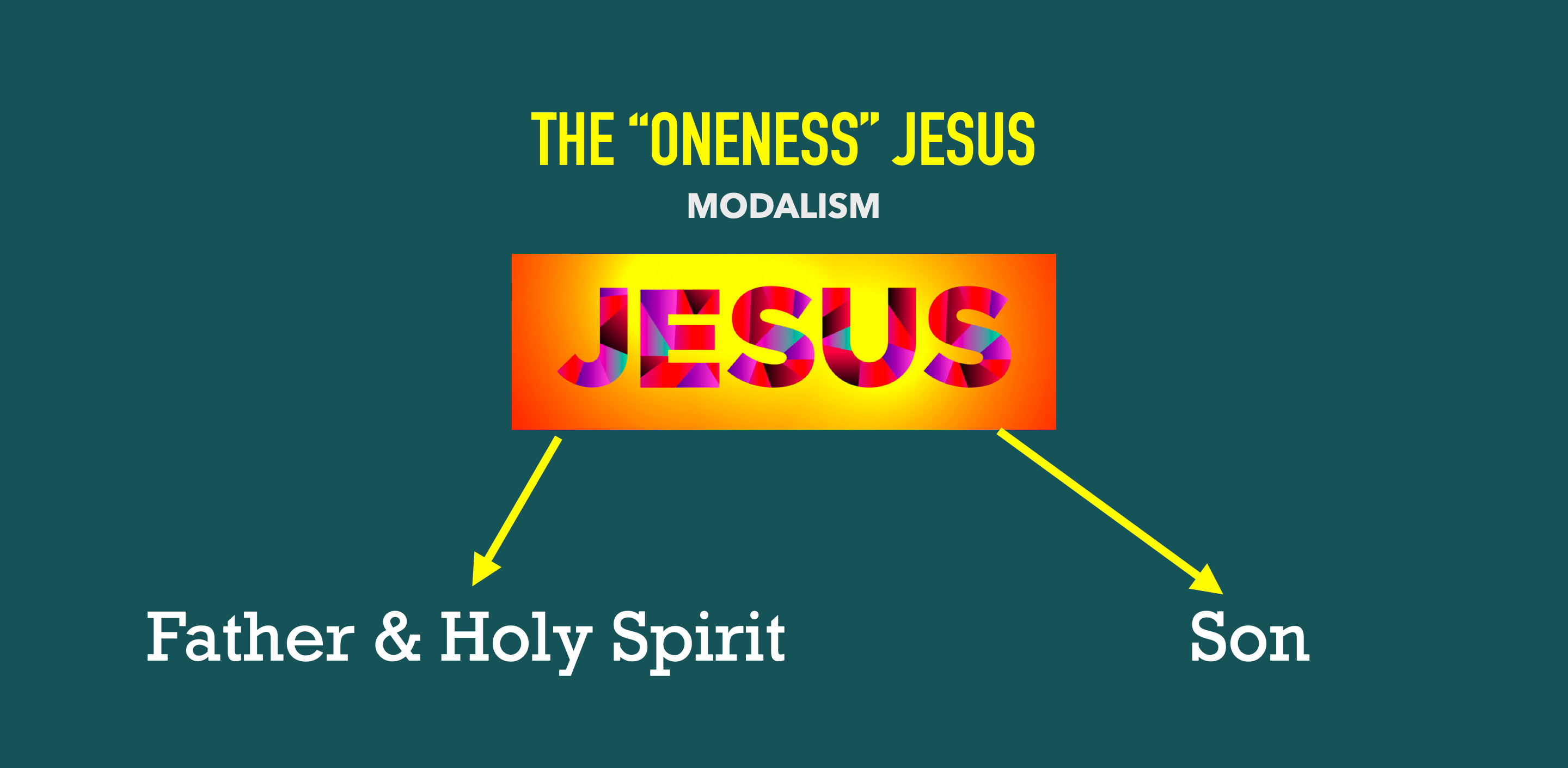
The term “Father” is understood by many Jews in at least two ways. They understand this term as God the Father relating to them being the father of the Israelite people (see, Isa. 63:16). While the other one connotes God being the “Father” of mankind being God as their Creator (see, Mal. 2:10). It is interesting to know that the “Oneness” cult members teach Jesus is “the Father” and “the Holy Spirit” in His divinity while “the Son” in His incarnated humanity. They are coming from a mindset that since a “Son” had a beginning therefore, this manifestation represents the humanity of Christ. Isn’t it that the term “Father” also had a beginning at the moment when He had a Son? No wonder many evangelicals do not believed in Eternal Sonship because they believed God is Yahweh from eternity to eternity.
But the Oneness people are not correct in their interpretation of the Scripture regarding the title “Son of God.” This title in reference to Jesus Christ means He had the nature of Yahweh being God. No wonder the Jews objected Him calling the Father as “my Father” because this shows His equality with the Father. (1) As John says, “This was why the Jews were seeking all the more to kill him, because not only was he breaking the Sabbath, but he was even calling God his own Father, making himself equal with God (John 5:18). They have an understanding that the nature of the source is the same from where it came, though, not in the sense of being created for that would make a different nature. For example, a mango fruit had the same nature as a mango tree. A kitten had the same nature as a cat. A pony had the same nature as a horse. It is no wonder that the book of Genesis says, “according to its kind” eight times in six verses (see Gen. 1:11, 12, 21, 25; 6:20; 7:14)
The Oneness heresy started to brew during the latter part of the second century until early part third century with a number of prominent modalist figure like Noetus, Zephyrinius, Sabbelius (Paul of Samosata), Callixtus, and others. Sadly, their heretical teachings spread until it reach our day and time. There are many Oneness theological cult groups here in the Philippines and all over the world. Some of them are the following:
- Jesus Miracle Crusade International founded by Wilde Estrada Almeda
- United Pentecostal Church International, a Oneness group that entered the Philippines in 1957 from where the other Oneness groups came.
- Jesus Christ To God Be the Glory founded by Louie Santos
- Living Stream Ministry founded by Witness Lee calling their groups as church in Manila, church in Malabon, church in Anaheim, etc. (2)
- End Time Message founded by William Marrion Branham
The Living Stream Ministry of Witness Lee claim to be Trinitarian but in reality, Lee embraced the Oneness doctrine but he and his associates would not admit it. He even admits, “When the Bible says that the Son is called the everlasting Father, I say, ‘Amen, the Son is the Father.’ I do not care how men interpret this verse; I only care for what the Bible says.”
This reasoning by Witness Lee is not correct because to accept everything as literal in the Bible will surely make many passages as absurd and non-sensical. Jesus claimed to be the Way, are we now going to say He is a road? Jesus claimed to be the Bread of Life, will they interpret that as a large bun? I hope you get this.
So, is the term “Everlasting Father” a relational term or descriptive of the nature of the son to be given based from Isaiah 9:6?
The name “everlasting Father” can also be translated as “Father of eternity” and that Father in this sense does not mean Jesus is “the Father” but rather the source of eternity, like Abraham Father of many nations, Ab being the Hebrew word for Father).
Since there is no adjective in Hebrew, a noun following another noun can function in a genitive construct form. The word “eternity” is in a genitive construct where it has relation with the word “father.” In the case of “Father of Eternity,” the word “eternity” (the head) possesses the “father” (the modifier). It like saying “John’s car” where the “car” is the head while “John” is the modifier. The same thing is true with “everlasting mountains” (“mountains of eternity) in Habakkuk 3:6 and “marble stones” (“stones of marble”) in 1 Chron. 29:2.
According to Dr. Edward Dalcour, author of A Definitive Look at Oneness Theology, “Along with the meaning of ‘Creator,’ the term “father” correspondingly carried the idea of ‘possesor of,’ ‘founder of,’ as with His creation. For example, 2 Samuel 23:31 speaks of Abiethon, which name means ‘father (or possessor) of strength (i.e., ‘strong one’) . In Exodus 6:24, we read of a man named ‘Abiasaph,’ whose name means, ‘father of gathering,’ that is, he who gathers. Thus, the Messiah is āb of eternity.” (3)
Another way of understanding “Everlasting Father,” literally “Father of Eternity” is by way of illustration. When we say Alexander Graham Bell is the “father of telephone” we do not mean Alexander has relationship with us because he is called father. What it means is he is the inventor (creator), possessor, or founder of that gadget. The same can be applied with Aristotle (father of biology), Karl Benz (father of cars), Galileo Galilei (father of science), Sir George Cayley (father of aerodynamics), Loie Pasteur (father of microbiology), and Andres Bonifacio (father of katipuneros). Of course, we can’t be literal with the name Abigail in Isaiah 63:16 because her name means “father of joy.”
Dr. Lawrence O. Richards, a prominent and prolific education writer among evangelical circle says in his book, Encyclopedia of Bible Words, “The key word for ‘father’ in the Bible is āb. It occurs 1,191 times in Hebrew and 9 times in Aramaic form. It is a complex word. Although it usually indicates a literal father or grandfather, it may also be used as a title of respect for a governor or prophet or priest…. Āb is also used to indicate the founder of a guild. Thus Ge 4:21 identifies Jubal as ‘Father of all who play the harp and flute”, i.e., he was the first musician… It is probable that the title ‘Everlasting Father’ ascribe to Messiah by Isaiah (Isa. 9:6) is better understood as “father of eternity,” i.e., founder of the ages.” (4)
Even in the Aramaic Targums, a commentary of the Hebrew Scriptures in Aramaic, says Dr. Dalcour, “Syntactically, the Hebrew term ‘father’ precedes the word translated ‘eternal’ (lit. “father eternal”), indicating the eternal nature of the Messiah. This thought is well revealed in the Aramaic Targums.” (5)
It is true that Jesus is the “Everlasting Father” or “Father of Eternity” not in the sense that He is the father of us all but He is the source of eternity, and the possessor of eternity who can give or dispense eternal life to those who believe in Him. This is because Jesus is the Alpha and the Omega, the First and the Last, and the Beginning and the End (see Rev. 1:8). Jesus is not the Father because He had a Father in terms of relationship (Economic Trinity).
Blessed be the God and Father of our Lord Jesus Christ, the Father of mercies and God of all comfort, – 1 Corinthians 1:3
End Notes:
1 The word “equal” came from the Greek word “isos” which is where we also get the word “isometric” meaning three equal sides. This truth about Jesus being equal in nature with Father is what the Unitarian cults would not want to admit and accept.
2 In the past Dr. Walter Martin, founder of the Christian Research Institute and the original Bible Answer Man exposed Witness Lee as a modalist or Oneness in our modern-day. The the leaders of the Living Stream Ministry continues to deny this by saying they are being misrepresented. They wanted to portray themselves as “Trinitarians” but in fact believes Jesus is the Father, who became the Son, and eventually the Holy Spirit being the ultimate consummation of the processed Triune God (see Being the Consummation of the Processed Triune God). Unfortunately, Hank Hanegraaff, the successor of Dr. Martin, along with his editor-in-chief namely Elliot Miller succumbed to finally embracing the theology of Witness lee as “orthodox” after a six-year of research. They have not seen the truth that Witness Lee is just playing with his semantics. Although Lee claims to believe in “three persons” in some of his articles, these “three persons” own the one name, which is Jesus Christ (see The History of God in His Union With Man). Dr. Walter Martin sees this deception, and he calls this dynamic modalism which the “local church” people continues to evade (see Biblical Theology. Witness Lee To the Local Church – Dr. Walter Martin. Access Nov. 26, 2020. https://www.youtube.com/watch?v=830hmhL-w6A.)
3 Edward Dalcour, “A Definitive Look at Oneness Theology,” (Lanham, MD: University Press of America, 2005), 22.
4 Lawrence O. Richards, “New International Encyclopedia of Bible Words” (Grand Rapids,: Zondervan, 1991), 266, quoted in Edward Dalcour, “A Definitive Look at Oneness Theology,” (Lanham, MD: University Press of America, 2005), 22.
5 Edward Dalcour, “A Definitive Look at Oneness Theology,” (Lanham, MD: University Press of America, 2005), 22.



0 Comments